Jump to a question in this guide
- What happens between the sink opening and the drain?
- How do the plate, impellers and grinding ring work together?
- Why is water transport a different job from grinding?
- What do the mounting, seal and discharge connections do?
- How can a dishwasher share the receiving drainage question?
- What controls the appliance, and why do exact instructions matter?
- Does a manufacturer’s food list decide what the sewer accepts?
- What changes when scraps follow a separate collection route?
- How should noise, odour, slow drainage and leakage be separated?
- What should service or replacement work actually establish?
- How would a fictional owner choose the next kitchen question?
- What should the next household understand at handover?
- Plate movement, blunt lugs and fixed ring perform distinct grinding jobs.
- Smaller particles still need water transport and suitable receiving drainage.
- Appliance instructions do not replace current local wastewater requirements.
- Sound, smell, drainage and external water need separate safe service questions.
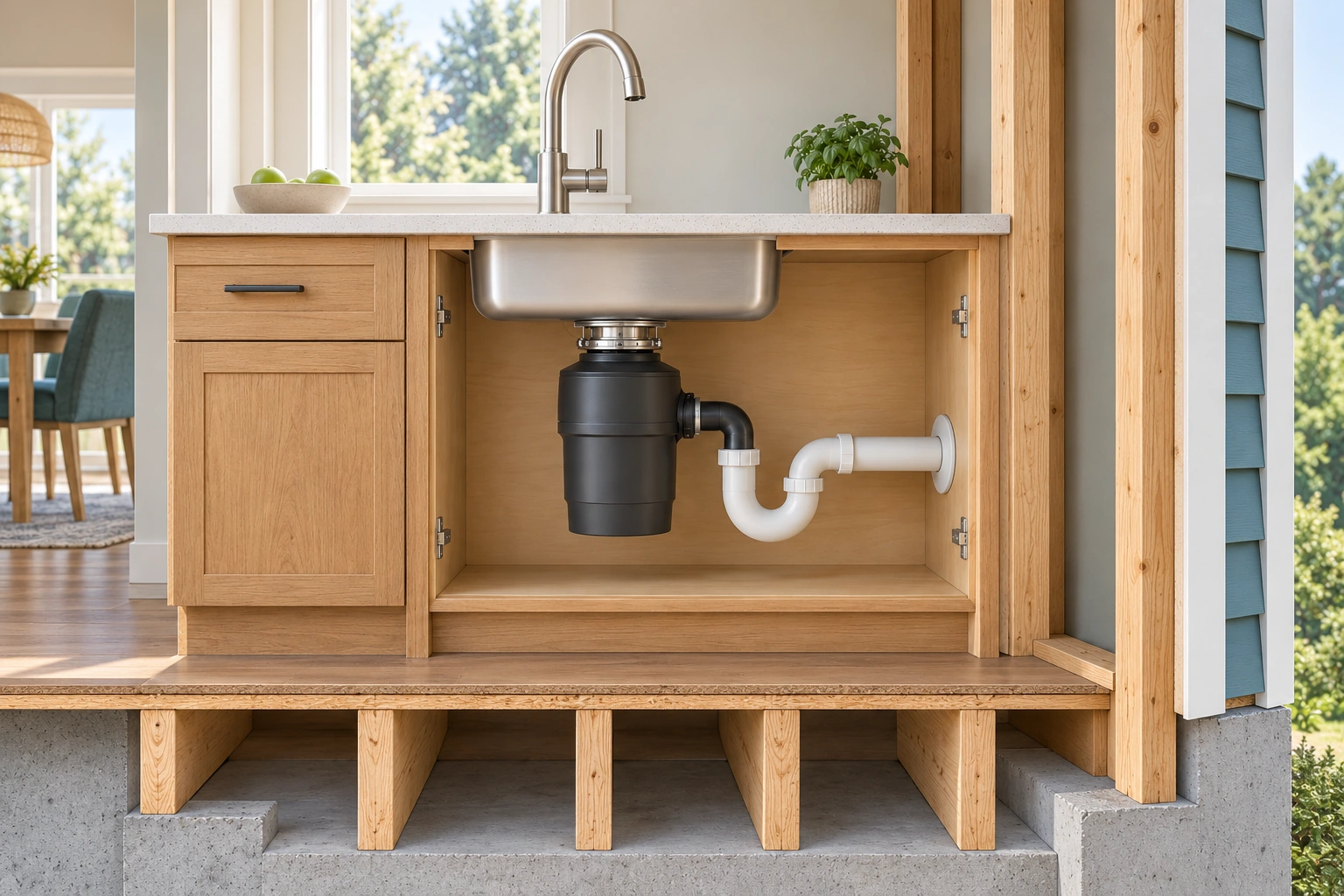
The house cutaway shows a sink over a closed disposer, with side discharge connected through a curved trap to the wall. Exposed framing gives building context.
About this illustration
No actual model, mount/seal condition, control circuit, drain approval or permission to operate. This is a conceptual teaching model, not an assessment of your home.
6 picture lessons appear beside the questions in this guide. Use them to understand the explanation, then consider what it means for your home.
What happens between the sink opening and the drain?
A kitchen waste disposer is an electrically powered appliance beneath a sink. Its grinding chamber reduces suitable food material before water carries particles into the connected drainage. The sink, appliance, electrical supply and building drain have separate jobs. A familiar humming sound or a sink that empties does not independently assess them all. Start by identifying the actual appliance, connection and concern.
The sink opening receives water and material. The disposer connects beneath it through a mounting and sealing arrangement. Its motor drives the grinding mechanism inside the chamber. A discharge opening then connects to the plumbing route. In the named manufacturer example, the outlet and any dishwasher inlet are distinct connections; their exact installed arrangement still needs its own records and professional assessment.
InSinkErator’s US mechanism explanation and its 2023 multi-model manual provide the named appliance context here. The manual is two very large physical sheets containing English, Spanish and French, marked 79841-ISE Rev B. It includes installation, operation, care and warranty material. Its many models, US web path and manufacturer descriptions do not establish Canadian approval or identify a unit in your home.
This guide owns the disposer’s grinding, water, control and drain handoff, together with local permission and service questions. The plumbing guide owns traps, vents and the wider network; the dishwasher guide owns washing and appliance discharge. The sewer and private-sewage guides own downstream assessment. Connecting those questions does not make a disposer a substitute for food-scrap collection or prove that a particular sewage system accepts it.
Sink, closed appliance and drain have different jobs
The house cutaway shows a sink over a closed disposer, with side discharge connected through a curved trap to the wall. Exposed framing gives building context.
Numbers identify the parts explained below.
- Sink interface
Visible collar is not a mounting assessment.
- Closed appliance
Motor housing remains enclosed.
- Drain route
Receiving plumbing retains its own scope.
What does this illustration leave out?
No actual model, mount/seal condition, control circuit, drain approval or permission to operate. This illustration explains an idea. It is not an installation guide.
Which actual appliance and receiving route were assessed?
Explore this with HomeAI ↗Opens an editable question. Nothing is sent until you choose to send it.How do the plate, impellers and grinding ring work together?
InSinkErator explains a mechanism that differs from a blender. Blunt impellers, also called lugs, sit on a rotating plate. As the plate turns, the lugs move food against a stationary grinding ring around the chamber. The ring breaks the material into smaller particles. The jobs are therefore motion, contact and size reduction rather than a set of sharp blender blades slicing food.
The native mechanism figure connects motor-driven plate movement, lugs moving material, the fixed ring and the outgoing water route. The chamber cutaway is a conceptual teaching view with the lower motor enclosed. It supplies no permission to open an appliance or insert a hand, finger, utensil or tool. A statement that the example has no blender blades does not make a grinding chamber safe to touch.
Reducing particle size does not make material disappear. It leaves particles and water for the drainage and receiving system to manage. The manufacturer’s description of very fine particles is a general explanation, not a measured result for every food, model or condition. Do not infer a permitted waste list, guaranteed drain passage or environmental benefit from that phrase.
If a reported event concerns changed grinding, preserve what was already noticed without reproducing it. Noise, a stopped motor and a drainage problem can relate to different functions. The qualified provider should identify the actual unit and assessment needed. This guide gives no chamber access, jam-clearing, impeller test or instruction to feed an object to demonstrate the mechanism.
The fixed ring and moving plate perform different jobs at the same place. Movement brings material repeatedly into contact with the grinding surface; the ring supplies the stationary boundary against which size reduction occurs. The discharge is another opening with another purpose. Naming those relationships helps a novice understand why a turning motor, a grinding result and outgoing water are separate observations even when the appliance makes them seem like one event.
Plate, blunt lugs and fixed ring are distinct parts
The conceptual upper chamber cutaway beneath a sink shows a horizontal plate, two blunt lugs and a fixed textured ring; the lower motor remains enclosed.
Numbers identify the parts explained below.
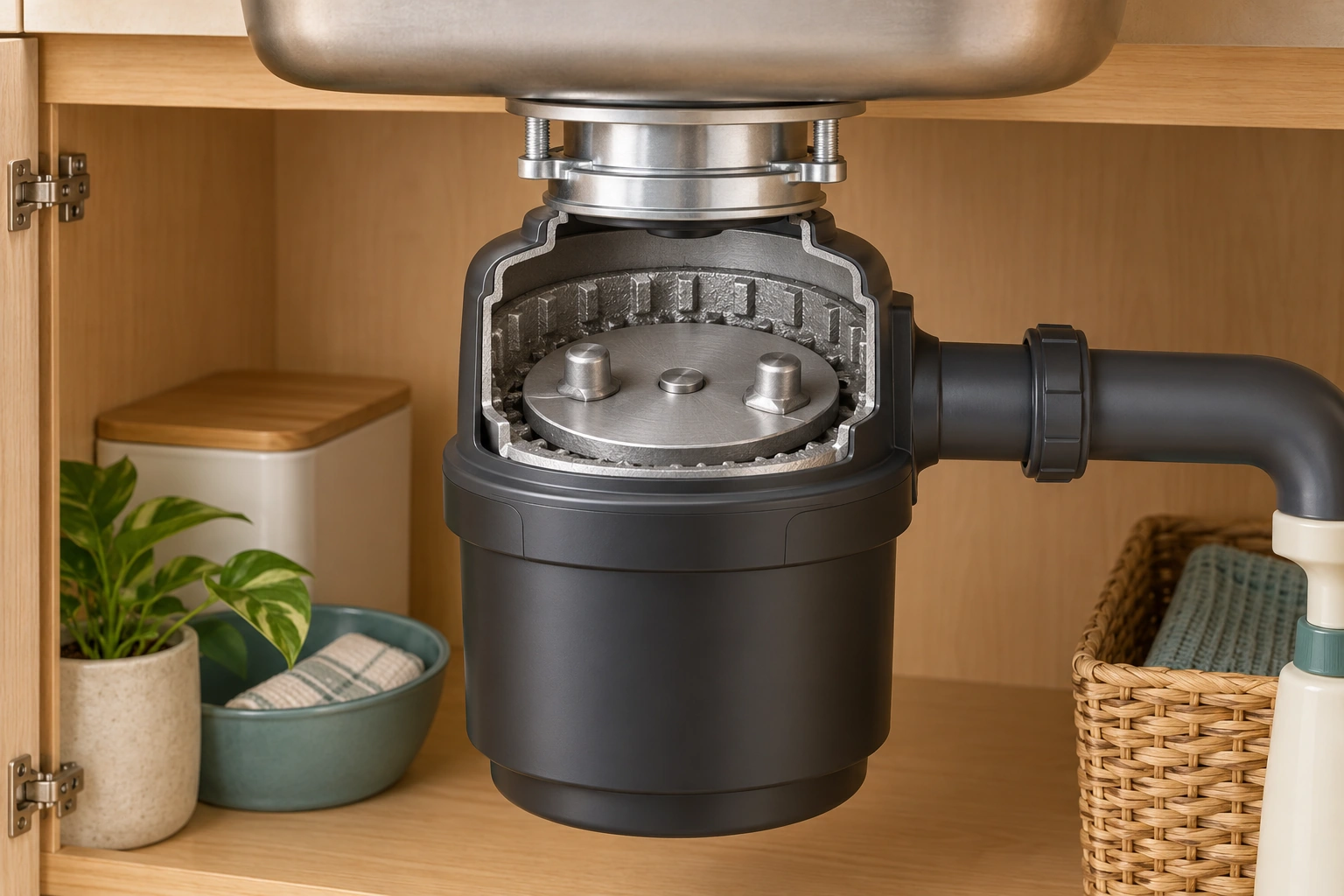
- Plate
Provides movement in the named explanation.
- Blunt lugs
Move material against the ring.
- Fixed ring
Stationary grinding surface, not blender blades.
What does this illustration leave out?
Generic teaching mechanism, not a detached actual unit, named-model detail or permission to touch/open/feed the chamber. This illustration explains an idea. It is not an installation guide.
How does the actual unit’s mechanism relate to the reported concern?
Explore this with HomeAI ↗Opens an editable question. Nothing is sent until you choose to send it.Grinding and transport are connected jobs
Original native teaching figure: Grinding and transport are connected jobs. Complete labels distinguish the conceptual functions; no actual property finding.
Numbers identify the parts explained below.
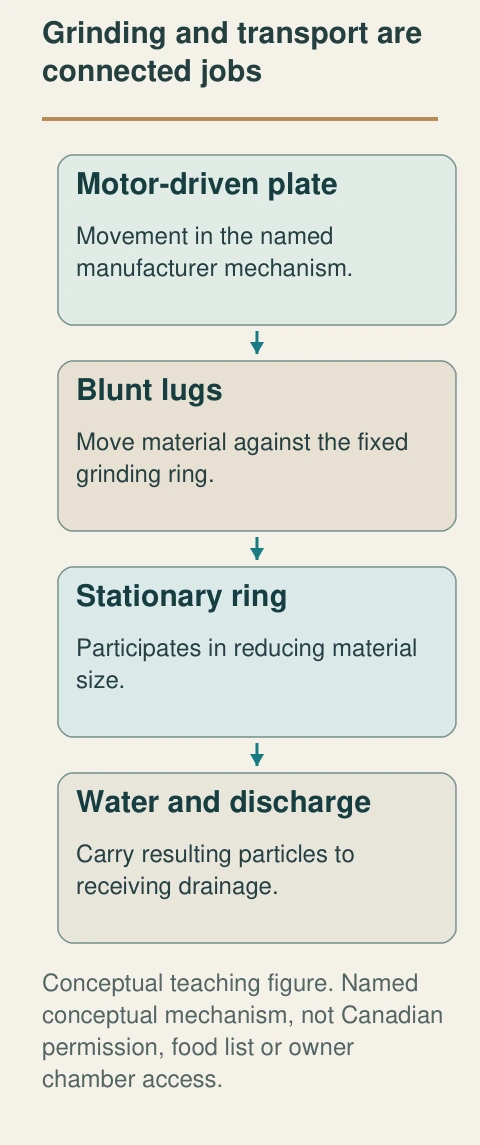
- Motor-driven plate
Movement in the named manufacturer mechanism.
- Blunt lugs
Move material against the fixed grinding ring.
- Stationary ring
Participates in reducing material size.
- Water and discharge
Carry resulting particles to receiving drainage.
What does this illustration leave out?
Named conceptual mechanism, not Canadian permission, food list or owner chamber access. This illustration explains an idea. It is not an installation guide.
Which actual mechanism and receiving route are identified?
Explore this with HomeAI ↗Opens an editable question. Nothing is sent until you choose to send it.Four connected mechanism jobs
- Motor and plateSupplies movement in the named appliance.
- Blunt lugsMove material toward the fixed ring.
- Grinding ringStationary surface participates in size reduction.
- Water/dischargeTransport reduced particles to the receiving route.
Conceptual named mechanism; no owner chamber access or feeding test.
Further reading: InSinkErator US · How a Garbage Disposal Works; InSinkErator · Installation, Care and Use: named Power/Evolution/PRO models.
Read the complete figure
Grinding and transport are connected jobs
Original native teaching figure: Grinding and transport are connected jobs. Complete labels distinguish the conceptual functions; no actual property finding.
- Motor-driven plate
- Movement in the named manufacturer mechanism.
- Blunt lugs
- Move material against the fixed grinding ring.
- Stationary ring
- Participates in reducing material size.
- Water and discharge
- Carry resulting particles to receiving drainage.
What remains unknown: Named conceptual mechanism, not Canadian permission, food list or owner chamber access.
A useful question: Which actual mechanism and receiving route are identified?
Why is water transport a different job from grinding?
Grinding changes the material inside the appliance. Water carries the resulting particles toward its discharge and connected drain. Those jobs depend on one another during the intended operation, but they are not the same function. Hearing a motor does not establish water transport, and water passing through the sink does not establish what the grinding mechanism did.
The named manual gives model-specific water and operating directions, and refers cover-control models to a separate guide. Follow the current instructions matched to the actual unit and locally permitted use. This article does not reproduce an operating sequence, flow amount, temperature or flushing duration. A general explanation of water’s role is not an instruction to run a questionable disposer or drain.
The receiving plumbing remains important after material leaves the chamber. Its actual connection, route and condition determine a separate assessment question. A new disposer attached to an old drain does not renew the drain. Likewise, a clear-looking sink opening cannot reveal the route behind the cabinet or the condition of piping beneath the building.
Keep source and destination in the same record: what appliance was used, what ordinary result was reported and which receiving route is actually identified. A slow sink may require plumbing assessment rather than a larger motor. A changed grind may need appliance assessment even when water later empties. The actual provider can connect supported findings without asking the owner to perform a feeding or drainage trial.
What do the mounting, seal and discharge connections do?
The sink mounting holds the appliance at its intended connection, while seals address water at the relevant interfaces. The discharge tube carries used water and particles onward. These are different physical jobs even though they sit close together in the cabinet. A neat collar or dry photograph does not establish that every support and sealing part matches the actual unit and sink.
The reviewed manual distinguishes sink flanges, mounting rings, gaskets, discharge components and some model-specific vibration arrangements. Those details explain why a replacement is not simply a matter of hanging any similar cylinder beneath the sink. The appropriate installer needs the matching documents and actual sink, appliance and drain context. No part number, fastening method or sealant recipe is supplied here.
A visible wet area can originate at different locations, including a sink junction, disposer connection, appliance body or another nearby pipe. The first place water appears may not establish its source. Do not fill the sink, operate the disposer or loosen a connection to trace it. Keep clear of potentially affected electrical surroundings and seek appropriate qualified help.
The whole-system cutaway locates a closed appliance, side discharge and separate trap in a skeletal cabinet. Its geometry is illustrative, not an approved installation or measured drain slope. Ask what the provider actually inspected, what work was completed and what verification was performed. A replaced connection remains a useful result with that scope; it does not certify every concealed part of the kitchen.
Support and watertightness should also remain separate in the work record. A mounting connection can hold an appliance while another junction leaks, and a dry moment does not establish how the unit is supported. The responsible installer should explain both questions within the actual scope. This is why a photograph of the collar and a note saying no leak seen are useful limited records rather than interchangeable evidence about the completed assembly.
How can a dishwasher share the receiving drainage question?
Some actual installations connect a dishwasher’s outgoing hose to a disposer inlet. In the named manual, that inlet is distinct from the disposer’s own discharge. A manufacturer installation step addresses an inlet plug for the dishwasher connection, showing why the receiving arrangement matters. This guide explains the interface without instructing an owner to remove a plug or disconnect a hose.
The dishwasher’s internal washing and drain functions remain separate from the disposer’s grinding. A dishwasher that retains water may raise questions about its own operation, outgoing hose or receiving plumbing. A nearby disposer does not prove the cause. Keep the actual model, connection and any recorded installation change with the service request.
The appropriate providers should explain which scope addresses the observed result. An appliance technician may assess internal dishwasher operation; a qualified installer or plumber may address the connected outgoing route. Electrical concerns need their own appropriate response. One provider can cover more than one role, but its written scope should make that explicit.
Do not pull out a built-in dishwasher, reach behind wet equipment, disconnect a hose or repeat a suspect discharge for evidence. A record that a disposer was replaced recently is useful sequence information without being a diagnosis. Ask whether the actual completed work included the dishwasher interface and which conditions were checked, leaving any unassessed route or internal function visible as a remaining question.
What controls the appliance, and why do exact instructions matter?
A control requests appliance operation, while the electrical supply provides the energy for the motor. Those are related but different dependencies. The reviewed multi-model manual mentions wall-switch and push-button air-switch control contexts, and refers cover-control models to separate instructions. An outside button or stopper shape therefore does not independently identify the complete control arrangement.
A reported stopped motor could have more than one explanation. The named manual discusses a possible jam and its automatic overload switch, but that does not establish the cause in an actual unit. Its troubleshooting and cooling instructions are deliberately not reproduced here. Do not repeatedly restart, reset or manipulate a control to distinguish causes.
Match the model and relevant control document before interpreting an ordinary-use account. The separately referenced cover-control and accessory guides have not been read for this article, so their operating mechanisms and procedures are not adopted. If the actual equipment uses them, obtain matching manufacturer and qualified service advice. A similar-looking switch is not a universal instruction.
An electrical or suspected internal concern belongs with the appropriate qualified provider. Keep people away from damaged equipment and wet electrical areas; immediate smoke, sparks, burning or another danger requires the appropriate emergency response. Do not remove a casing, alter wiring, force a plug or test a circuit using this lesson. The useful service account names the actual control and event without creating another event.
Does a manufacturer’s food list decide what the sewer accepts?
The appliance and wastewater system answer different questions. A manufacturer describes what its named product is intended to grind. A municipality or private-sewage authority addresses what the receiving system permits or can appropriately manage. Neither should silently replace the other. Confirm current local requirements before adding, replacing or using a disposer in the actual property.
Calgary’s current fats, oils and grease guidance explains that material can cool, adhere to sewer pipe walls and restrict flow. It explicitly rejects the idea that a garburator makes fats, oils and grease acceptable down the drain. Its green-cart guidance offers a separate route for food scraps. These are Calgary examples, not a national waste-disposal rule or proof that every local installation is prohibited.
The manufacturer’s US manual contains food and cleaning suggestions that this article does not adopt as a general Canadian permitted list. Local collection directions can also differ from a manufacturer’s trash suggestion. Ask the actual municipality, building authority and appropriate installer which current requirements apply, and keep any actual answer with its location and date.
A disposer described as suitable for septic use does not assess your private sewage system, its loading or local permissions. The mechanism page’s reference to wastewater treatment or septic destinations is a general route description, not system acceptance. Bring the proposed equipment and household use to the relevant qualified private-sewage provider and local authority before treating a product label as the decision.
Instructions, destination and collection differ
Original native teaching figure: Instructions, destination and collection differ. Complete labels distinguish the conceptual functions; no actual property finding.
Numbers identify the parts explained below.
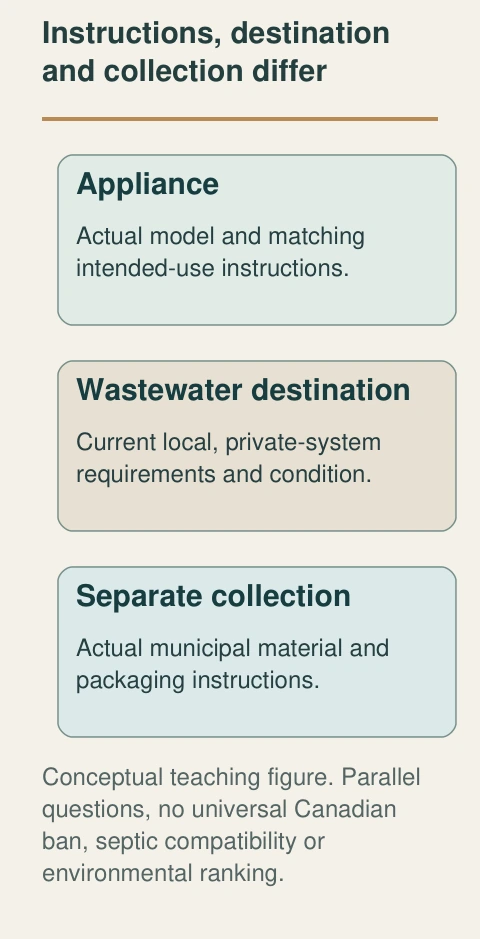
- Appliance
Actual model and matching intended-use instructions.
- Wastewater destination
Current local, private-system requirements and condition.
- Separate collection
Actual municipal material and packaging instructions.
What does this illustration leave out?
Parallel questions, no universal Canadian ban, septic compatibility or environmental ranking. This illustration explains an idea. It is not an installation guide.
What does each actual source establish for this home?
Explore this with HomeAI ↗Opens an editable question. Nothing is sent until you choose to send it.Three different permission questions
- ApplianceActual model and matching intended-use instructions.
- Receiving wastewater systemCurrent local/private-system requirements and condition.
- Separate collectionActual municipal material/packaging directions.
No national disposer ban, septic acceptance or universal waste list.
Further reading: InSinkErator · Installation, Care and Use: named Power/Evolution/PRO models; City of Calgary · Fats, oils and grease management; City of Calgary · What can go in your green cart.
Read the complete figure
Instructions, destination and collection differ
Original native teaching figure: Instructions, destination and collection differ. Complete labels distinguish the conceptual functions; no actual property finding.
- Appliance
- Actual model and matching intended-use instructions.
- Wastewater destination
- Current local, private-system requirements and condition.
- Separate collection
- Actual municipal material and packaging instructions.
What remains unknown: Parallel questions, no universal Canadian ban, septic compatibility or environmental ranking.
A useful question: What does each actual source establish for this home?
What changes when scraps follow a separate collection route?
A food-scrap caddy keeps material separate from sink wastewater for the applicable collection or composting arrangement. The alternative kitchen picture shows a closed caddy and ordinary strainer-equipped sink as distinct routes. It is not a universal waste list, composting method or declaration that every collection service accepts the same contents.
Calgary’s green-cart page lists food categories and preparation requirements within that municipal programme. Use the current local instructions for the actual item and packaging. A manufacturer’s ability to grind a material is not needed to decide that local collection question. Conversely, an item accepted by a green-cart service is not automatically appropriate for an appliance or drain.
Compare alternatives by the actual household task and receiving route. A sink without a disposer still needs suitable drainage and care, while separate collection has its own storage and service requirements. This article supplies no price, water-use comparison, life-cycle emissions ranking or guaranteed environmental advantage. The reviewed manufacturer’s broad sustainability marketing is deliberately withheld.
For a planned kitchen change, ask whether retaining, replacing or omitting a disposer changes the sink, plumbing, electrical and cabinet scope. The responsible providers should explain the actual work and relevant approvals. A decision to collect scraps separately does not authorize disconnecting equipment or leaving an unused connection unassessed. Keep the chosen arrangement and completed work with the household instructions.
Separate collection is separate from sink drainage
An ordinary sink with strainer drains through a connected trap; a closed teal food-scrap caddy sits separately on the counter. No disposer is shown.
Numbers identify the parts explained below.
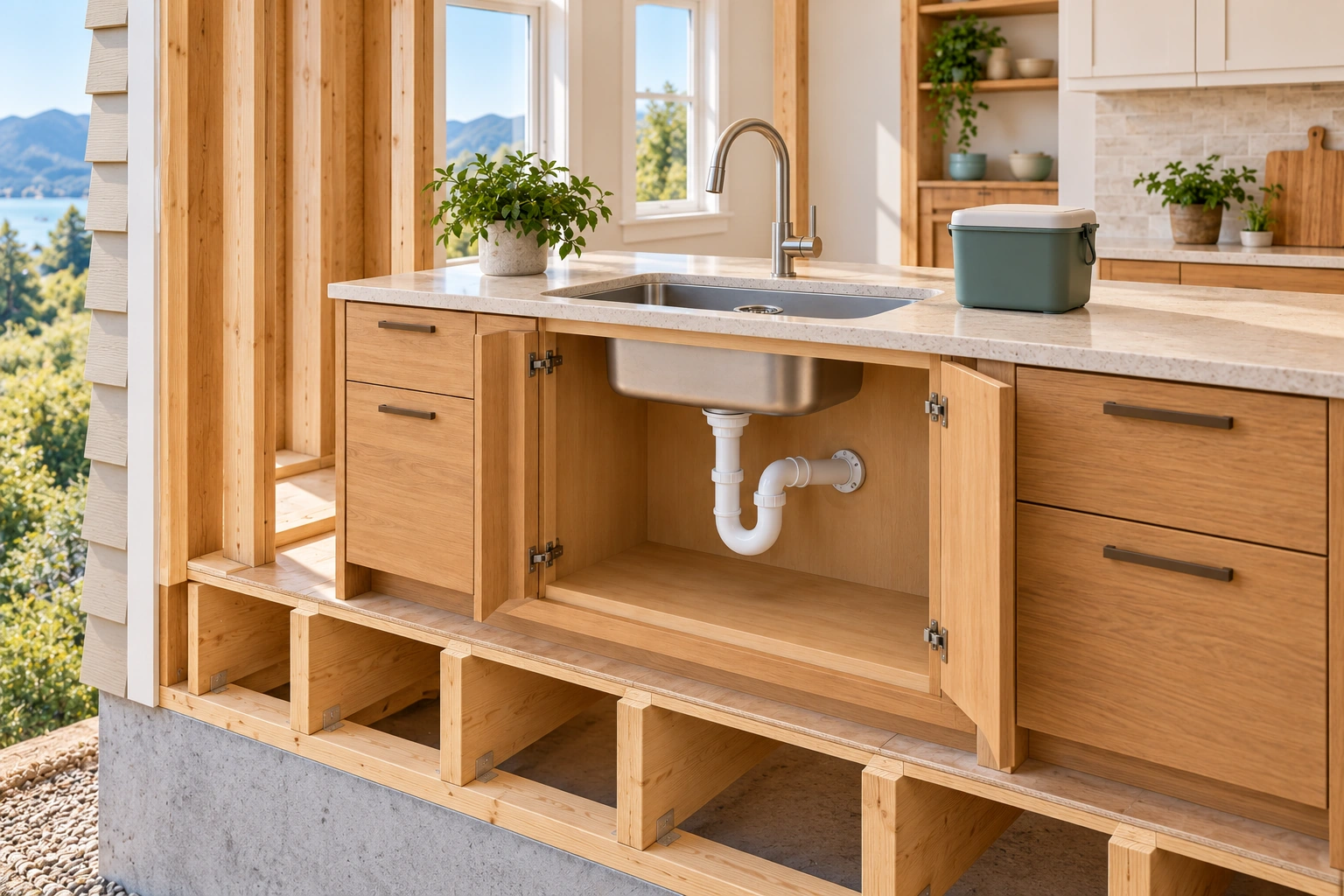
- Sink
Ordinary water route.
- Trap
Connected receiving-plumbing context.
- Closed caddy
Separate collection context, not a disposal recipe.
What does this illustration leave out?
No universal collection list, local acceptance, drain condition or environmental ranking. This illustration explains an idea. It is not an installation guide.
What actual collection and wastewater instructions apply?
Explore this with HomeAI ↗Opens an editable question. Nothing is sent until you choose to send it.How should noise, odour, slow drainage and leakage be separated?
These observations concern different functions. A changed noise describes sound and sequence. An odour describes a noticed smell without identifying its source. Slow drainage describes a result at a fixture. External water describes material outside an intended route. Several can occur together without sharing a proven cause; none alone establishes a failed motor, defective seal or blocked building sewer.
The named manual describes food accumulation in the chamber and baffle as an odour context, while the wider plumbing has its own trap, vent and drainage functions. Treat those as possible questions for appropriate assessment. This guide gives no chemical remedy, drain cleaner, citrus or ice method, baffle removal or odour test. Mixing household products or feeding material to diagnose a smell is not part of the lesson.
Record what was already observed: actual sink, approximate date, relevant ordinary-use sequence, any safe existing photograph and the source of a reported account. Keep recent work and its stated scope alongside the observation. Do not put fingers, hands, utensils or tools into the unit, get beneath an unstable mounting or reproduce a suspected leak or jam for evidence.
A useful request asks the responsible provider which appliance, connection or receiving-plumbing function needs assessment and what access it requires. If the concern reaches affected cabinetry or building materials, keep that separate task visible. A clear cause may emerge from qualified findings, but an unresolved cause should remain unresolved rather than being filled by a confident guess from a sound or smell.
Name the result before choosing a scope
Original native teaching figure: Name the result before choosing a scope. Complete labels distinguish the conceptual functions; no actual property finding.
Numbers identify the parts explained below.
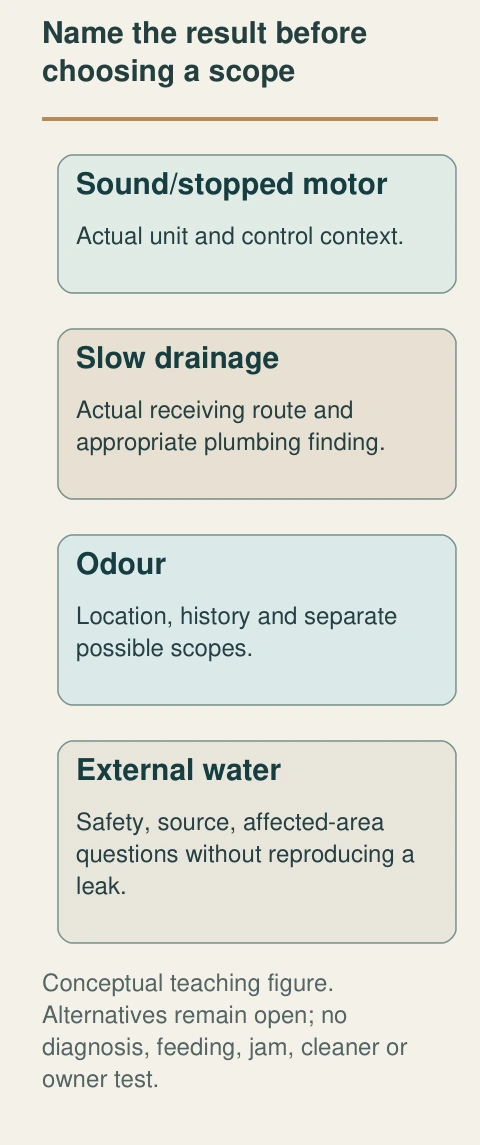
- Sound/stopped motor
Actual unit and control context.
- Slow drainage
Actual receiving route and appropriate plumbing finding.
- Odour
Location, history and separate possible scopes.
- External water
Safety, source, affected-area questions without reproducing a leak.
What does this illustration leave out?
Alternatives remain open; no diagnosis, feeding, jam, cleaner or owner test. This illustration explains an idea. It is not an installation guide.
Which supported finding connects the observation to proposed work?
Explore this with HomeAI ↗Opens an editable question. Nothing is sent until you choose to send it.Name the observed result
- Sound or stopped motorActual control/unit context and qualified assessment.
- Slow sinkActual receiving route and relevant plumbing finding.
- OdourLocation/history with possible appliance and plumbing scopes.
- External waterSafety/source/affected-area scope, no reproduced leak.
Alternatives remain open; no diagnostic trial or cleaning recipe.
Further reading: InSinkErator · Installation, Care and Use: named Power/Evolution/PRO models.
Read the complete figure
Name the result before choosing a scope
Original native teaching figure: Name the result before choosing a scope. Complete labels distinguish the conceptual functions; no actual property finding.
- Sound/stopped motor
- Actual unit and control context.
- Slow drainage
- Actual receiving route and appropriate plumbing finding.
- Odour
- Location, history and separate possible scopes.
- External water
- Safety, source, affected-area questions without reproducing a leak.
What remains unknown: Alternatives remain open; no diagnosis, feeding, jam, cleaner or owner test.
A useful question: Which supported finding connects the observation to proposed work?
What should service or replacement work actually establish?
Ask for the exact model, control arrangement and matching current instructions, along with the assessed concern and inspection limits. A proposal should distinguish investigation, appliance repair or replacement, connected plumbing, electrical work and restoration. The actual providers and local authority determine the requirements; this page invents no nationwide licence, permit exemption or approval from the appliance category.
A replacement needs the actual sink, mount, drain and any dishwasher interface considered together. Similar external size or a stronger marketed motor does not establish compatibility. Ask what remains from the previous installation and which new components or connections are included. The old unit’s age is history, not a condition diagnosis or a prescribed replacement deadline.
Completion records should describe the identified work, findings and verification under the stated conditions. An invoice for a disposer does not independently assess the receiving sewer or every dishwasher function. Retain any actual local permission, manufacturer directions and outstanding task with the specific equipment rather than turning a successful demonstration into a whole-kitchen clearance.
Warranty, insurance and contractual rights depend on the actual documents and advisers. The historical multi-model manual includes warranty durations and US-oriented legal terms, but this article adopts no entitlement or promised remedy. Preserve the relevant purchase and work records, and ask the actual manufacturer or adviser about the unit. A source’s printed copyright and current hosting are kept separate from a current coverage finding.
The assessment can identify a dependency without concluding that the dependent part failed. For example, outgoing water needs a suitable receiving route, but knowing that relationship does not diagnose a reported restriction. Ask which actual finding supports the proposed change and which alternatives remain. That question allows a limited appliance repair to stay limited, or a wider plumbing task to be justified by its own evidence, instead of assuming every symptom requires replacing the component nearest the sink.
How would a fictional owner choose the next kitchen question?
Lena is a fictional owner with a disposer beneath the kitchen sink. An existing account describes a changed sound, while a later note mentions slow sink drainage. A dishwasher is nearby, but its actual outgoing connection is not identified in the file. A replacement quote names a new disposer without describing the drain or dishwasher interface. None of these records proves that a larger appliance resolves the concern.
Lena supplies the existing observations and model information to the appropriate provider and asks which functions the assessment covers. The plumber can explain the actual receiving route and any relevant dishwasher connection; appliance service can assess the identified disposer scope. She also confirms current local waste and installation requirements before agreeing work. No jam-clearing, feeding or drainage trial is invented.
Suppose a revised proposal separates the supported appliance task from a remaining plumbing question. Lena retains both, along with matching instructions and completed-work evidence. If separate scrap collection is chosen, the equipment and plumbing changes still receive their appropriate scope. The hypothetical file does not turn a quote, removal or ordinary sink view into proof of a clear downstream sewer.
This example supplies no actual defect, repair success, local permission, septic acceptance, cost or warranty outcome. Its decision is to connect grinding, transport, receiving drainage and household waste choices before replacing equipment on the strength of one symptom. The resulting service question is clearer while the actual cause and completion remain open until appropriate evidence supports them.
What should the next household understand at handover?
Keep the actual equipment identity, control arrangement, matching instructions, relevant local advice, installation and service work together. Describe which connections were identified and which remained concealed. Include any dishwasher interface, receiving-plumbing task and affected-material assessment within its own stated scope. The next person should not have to infer those facts from a shiny appliance or an unexplained invoice.
Use the plumbing guide for the trap, vent and wider drainage questions, the dishwasher guide for appliance washing and outgoing water, and the sewer or private-sewage guide for the destination. Keep separate collection instructions with the actual local programme. These linked functions deepen the right question without turning this article into an installation, drain-clearing or private-system design manual.
The reader should finish able to explain how a motor-driven plate and blunt lugs move material against a fixed ring, why water and a receiving drain still matter, and why the control, mounting and connections need matching evidence. They should know how to preserve a safe observation and obtain the relevant professional scope. That understanding supports a useful handover without inviting an owner to investigate inside the appliance.
Keep learning about the connected parts
- How home plumbing works: supply, drains, vents and pipe materials
- Dishwashers: understand washing, draining and drying
- Home sewers explained: drains, buried pipes, roots and camera reports
- Build a home-care record that the next person can understand
Canadian context and authorities · Visual atlas · Learning labs
Practice the distinction.
Lena separates a sound from slow drainage
Fictional existing disposer sound and later slow sink; dishwasher outgoing connection unidentified.
Reported observations
- A quote for a new appliance does not assess receiving drainage.
- The actual control and installation identity need matching records.
- Local wastewater/collection requirements retain their own scope.
Compare the explanations
Expand each possibility to see the evidence needed to distinguish it. Similar symptoms can have different mechanisms.
The appliance task is supported
A qualified finding can define a limited unit scope.
Actual model, assessed concern and completion limits.
The receiving route needs separate assessment
A connected drain dependency is not itself a diagnosis.
Appropriate plumbing/dishwasher-interface findings.
A useful next question
Resolve the actual appliance, connection and local-use questions before agreeing work.
No actual defect, repair result, permission, septic acceptance, price or warranty outcome.
Know what the words mean.
- Impeller or lug
- A blunt part on the named rotating plate that moves material against the fixed grinding ring.
- Grinding ring
- The stationary chamber surface against which the named mechanism reduces material.
- Discharge
- The appliance’s outgoing water/particle connection to receiving drainage.
- Sink flange
- A named sink-interface part, distinct from the complete mounting and seal assessment.
- Receiving system
- The actual building drain and sewage destination with its own conditions and local requirements.
Questions to bring
to the conversation.
- Which actual appliance and control arrangement are identified?
- Which grinding, water or drainage result was already observed?
- What mount, discharge and dishwasher interfaces were assessed?
- Which local wastewater/private-system requirements apply?
- What actual work and verification scope transfer at handover?
Separate a showing observation, an existing record and a new professional assessment. Unknown means a question remains; it does not automatically mean a defect.
Use the evidence planner ↗Go to the source.
Original HomeAI explanation informed by these public references. Sources support the underlying guidance; they have not reviewed or endorsed HomeAI. Diagrams are conceptual, and calculator outputs depend on your inputs.
Full current manufacturer mechanism, all two oversized2023 multi-model/trilingual manual sheets, and complete Calgary wastewater/green-cart bodies readOctober14. Printed edition/US/local scopes retained. No operating/jam/installation/chemical sequence, universal Canadian permission, septic compatibility, environmental ranking or actual outcome. Separate accessory manuals not read. Fictional Lena case supplies no property result.
Publication & source review
First published .
Sources reviewed .
Have a question about your home?
Start with the symptom, timing and what you have observed.
Ask HomeAI