- A weak stream describes delivered flow; it does not supply a pressure reading.
- Compare location, hot/cold use, timing and ordinary simultaneous demand without deliberately stressing the system.
- Professional readings need the measurement point, units, instrument and operating conditions before comparisons mean much.
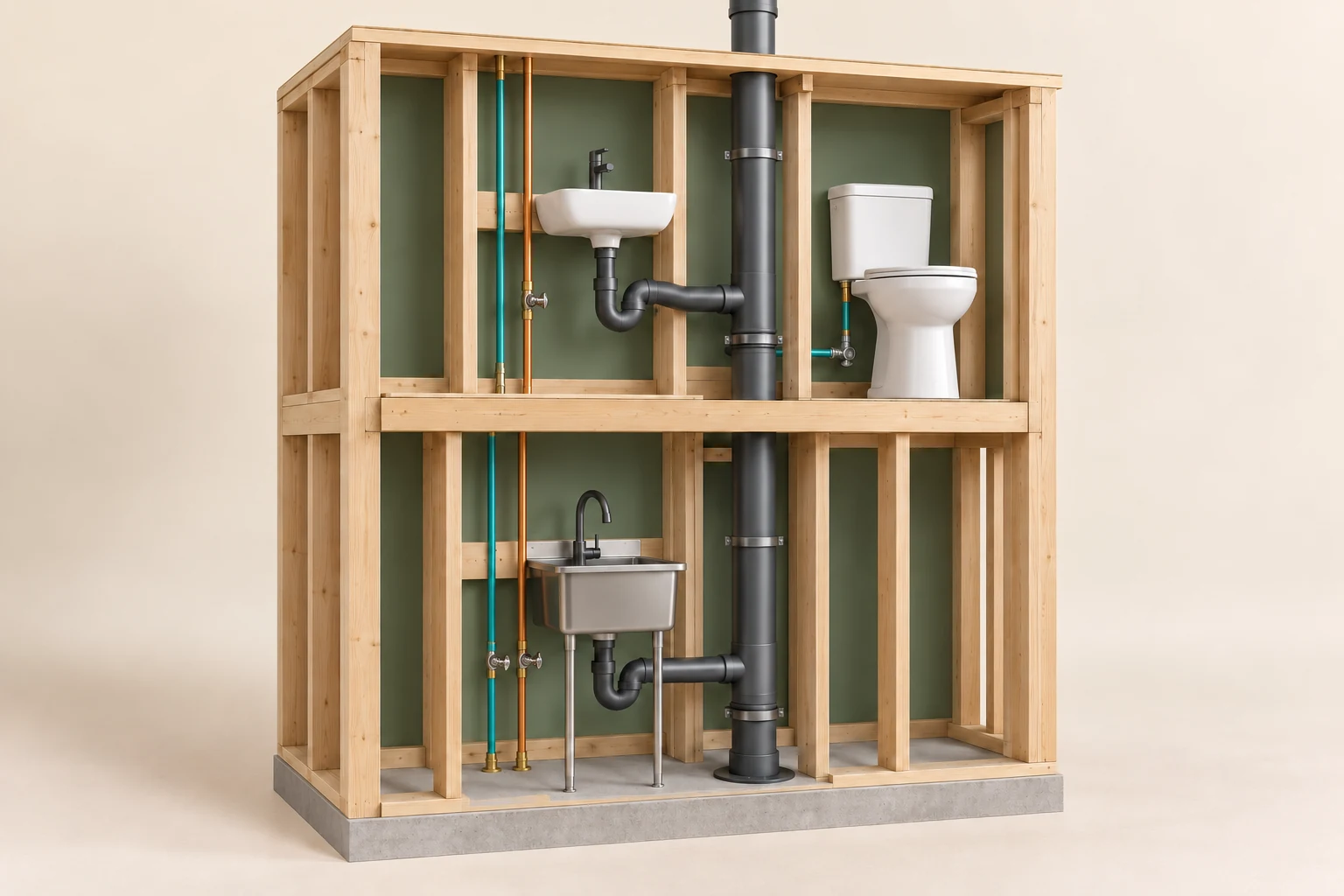
Supply pipes bring water to taps and appliances. After use, water leaves each sink through a drain and trap before joining the larger drainage route. The trap holds a water seal that limits gas passage into the room. Venting lets air circulate in the drainage system and helps protect those seals. Following these different jobs makes a repair record much clearer than calling everything plumbing.
About this illustration
The cutaway omits the tap connections, water inside the traps and a complete vent route to outside air. Pipe colour does not identify material. Ask a qualified plumber to explain the actual arrangement; this picture supplies no local design or approval. This is a conceptual teaching model, not an assessment of your home.
2 picture lessons appear beside the questions in this guide. Use them to understand the explanation, then consider what it means for your home.
Does a weak stream mean the water pressure is low?
Pressure describes force acting over an area; flow rate describes water volume delivered over time. A pressure gauge and a timed-volume record therefore answer different questions. A tap that feels weak gives you an observation about its delivery. The stream alone cannot tell you the pressure at the service entry, before a treatment device or elsewhere in the home.
Water must travel through the actual service, distribution pipes, fittings, valves and fixture outlet. Restrictions along that route affect delivery while water is moving. An outlet designed to limit flow can also produce less volume than a different outlet under comparable conditions. EPCOR specifically includes low-flow fixtures and their manuals among the questions behind a weak-stream complaint.
Write kitchen cold stream became weaker than its usual behaviour instead of pressure is below code. The first statement can be compared with later ordinary use. The second needs a suitable measurement and an applicable requirement. Record whether the change is new, longstanding or only newly noticed; a buyer’s first impression has no established before-and-after baseline.
Why does one fixture point to a different question from the whole home?
Start with the affected locations. One outlet, one room, several fixtures on a reported branch and most of the home are useful categories. Keep the branch reported until drawings or a plumber establish the route. The skeleton picture separates supply specimens from drainage, but it cannot show which concealed junction serves your kitchen or bathroom.
For a local problem, fixture components, a connecting hose or local valve are possibilities. For broader changes, common parts of the supply route, equipment and utility conditions deserve attention. EPCOR and Calgary list several such alternatives. An unaffected fixture makes the comparison useful; it does not prove every pipe upstream is clear or every common device is functioning correctly.
Use observations from normal household activity rather than a marathon of test runs. Note the outlet and control used, the usual versus changed behaviour, and anything already altered. Photograph an accessible product identifier if safe. Cleaning, replacing or removing a component changes the evidence, so record that work and follow the actual product instructions or obtain service.
Water comes in; used water leaves through a different system
Supply pipes bring water to taps and appliances. After use, water leaves each sink through a drain and trap before joining the larger drainage route. The trap holds a water seal that limits gas passage into the room. Venting lets air circulate in the drainage system and helps protect those seals. Following these different jobs makes a repair record much clearer than calling everything plumbing.
Numbers identify the parts explained below.
- Water supply
The narrow runs illustrate water delivery to fixtures. Incoming pressure provides the push; the drains carry used water away separately. A supply replacement record should name the branches and endpoints it covers.
- Sink trap
Water retained in an installed trap forms a barrier against gas from the drain. The curved shape helps locate that part here, but the picture does not show its retained water or establish its condition.
- Drainage and venting
The larger vertical pipe illustrates a stack carrying drainage between floors. Venting has the separate air-circulation and trap-protection job. Ask where each fixture drains and how its trap is vented; those complete connections are not drawn.
What does this illustration leave out?
The cutaway omits the tap connections, water inside the traps and a complete vent route to outside air. Pipe colour does not identify material. Ask a qualified plumber to explain the actual arrangement; this picture supplies no local design or approval. This illustration explains an idea. It is not an installation guide.
Which pipes supply this fixture, where does its used water go, and how does the actual vent arrangement protect its trap seal?
Explore this with HomeAI ↗Opens an editable question. Nothing is sent until you choose to send it.What does a hot-only or cold-only change tell me?
Hot water has an additional equipment and distribution context. A weak hot stream at several fixtures can raise a heater, mixing arrangement or hot-distribution question that a cold-only observation does not. Calgary directs hot-water-only pressure concerns to a plumber. That is a referral to investigate the relevant route, rather than a finding that the water heater has failed.
Record the control position and what you could distinguish safely during ordinary use. A single-handle mixing tap may not reveal each supply separately. A change in delivered temperature also differs from a change in delivered volume. Preserve both observations if present: the shower became cooler while another fixture was used is more precise than all the pressure disappeared.
Supply-device identity matters here. A treatment device might serve only selected outlets or a portion of the supply; a recirculation or mixing arrangement adds other connections. Have a qualified person establish those routes when needed. Do not operate an unfamiliar bypass, change heater controls or disconnect supplies to turn a pattern into an apparent component diagnosis.
Why can another normal water use change the shower?
Several demands can share parts of a supply route. When more water moves through a common section, the pressure available along the routes can change because moving water encounters resistance. The resulting delivery also depends on the fixtures and equipment. A pressure-reducing valve is one possible component, rather than a guarantee of unlimited volume at every outlet.
Observe which demand actually overlapped. A washing machine may use water during only part of its cycle; saying the machine was on is less precise than noting that it was filling. Record the sequence naturally encountered: shower felt weaker during kitchen use, then recovered after the kitchen tap closed. Do not ask someone to cycle appliances or valves rapidly to exaggerate it.
The comparison helps a plumber decide what to measure and where. It cannot quantify the pipe restriction or allocate blame between the fixture, branch and incoming service. Keep ordinary-use observations separate from a professional controlled measurement. If an event involves banging when filling stops, the water-hammer guide covers that transient question; steady weak delivery needs its own evidence.
How is static pressure different from pressure while water flows?
A static reading is taken under an identified no-flow condition at the measurement point. A flowing reading records pressure while a defined demand is occurring. Water resistance becomes relevant during delivery, so a reassuring no-flow value does not by itself establish how a shower will perform under use. The two conditions belong beside the numbers in a report.
The Watts LF25AUB instructions distinguish no-flow pressure from other conditions and discuss multiple reasons pressure may rise downstream. Their product preset is specific to that regulator, not a national household target. A professional should identify the actual device and system before interpreting readings. The guide provides no adjustment direction or universal acceptable-pressure range.
Ask for the measurement point, whether it is upstream or downstream of identified equipment, units and ordinary demand present. Confirm how no-flow conditions were established, including automatic uses that matter to the assignment. A gauge connected at one point cannot directly report every outlet pressure. Comparable readings use a stated method and conditions, rather than a collection of unlabeled photographs.
What should a pressure-and-flow measurement record contain?
The professional brief should name the decision: explain delivery at a particular fixture, evaluate an identified device, or distinguish an incoming-service concern from indoor distribution. That determines useful locations and operating conditions. Request the instrument identity and relevant accuracy or range, measurement units, date and time, observed demands and the limitations of the assignment.
Keep pressure units beside pressure readings, and flow units beside flow results. Ask which readings share a method and which came from different locations or conditions. A professional comparison across identified equipment can address a narrower question than an overall household impression. It should state the basis of its interpretation, rather than treating any two recorded numbers as interchangeable.
Keep steady readings distinct from brief events. Watts identifies a named gauge that retains the highest pressure during its observation period. A retained maximum and a time-resolved event record contain different information; neither supplies the other automatically. If the concern is intermittent, ask whether the planned method can capture its timing, and what a visit without the symptom could establish.
A route is different from a tested system
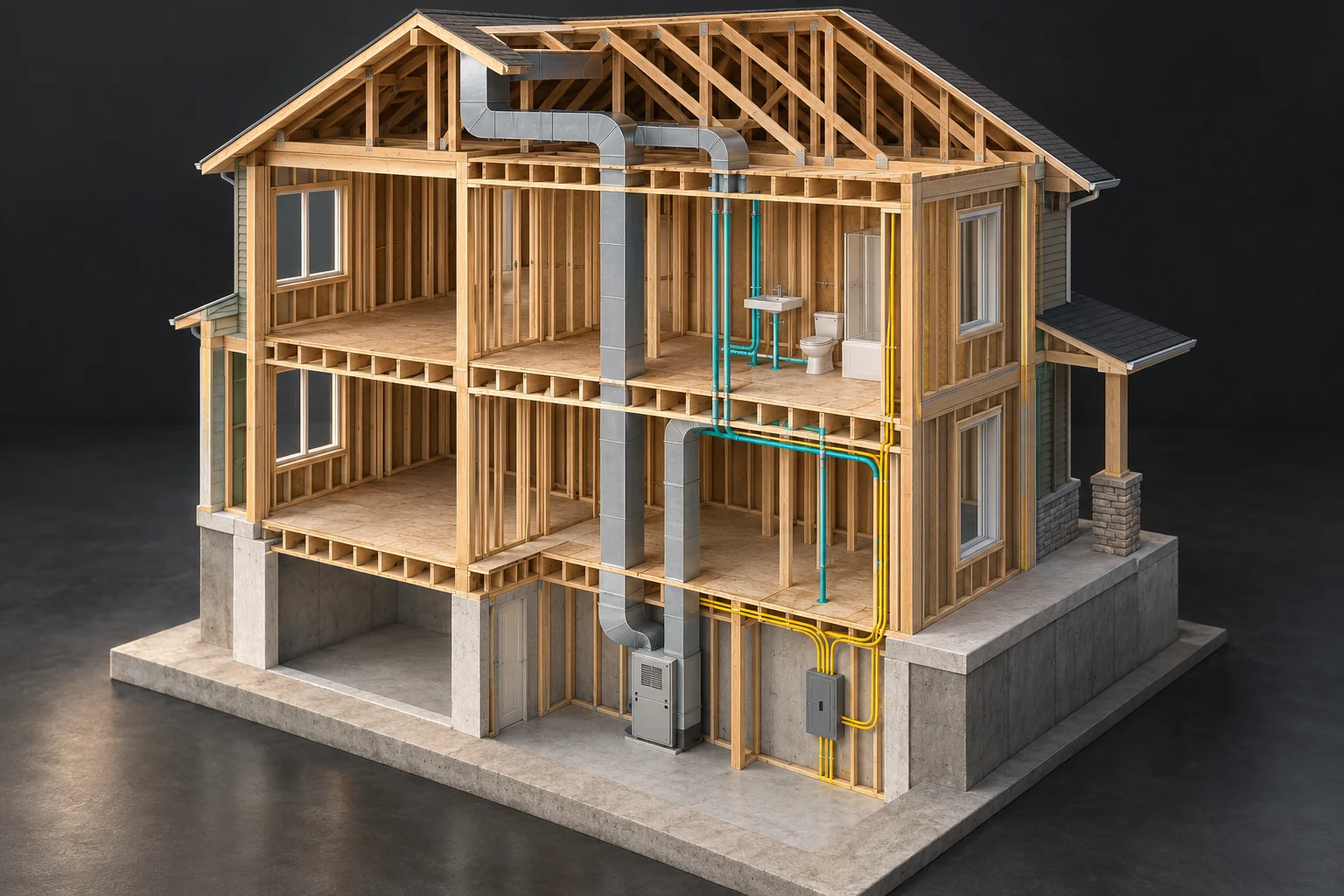
Visible routes locate different system functions. Closed equipment keeps this a planning illustration.
Numbers identify the parts explained below.
- Routes
Trace the question using records; colour is only this illustration’s key.
- Closed equipment
A professional defines access and measurements. Do not open a panel for this lesson.
- Room endpoint
A symptom at one room does not locate the fault.
What does this illustration leave out?
Capacity, continuity, hidden condition, electrical safety and actual delivered performance are not established. This illustration explains an idea. It is not an installation guide.
Which safe observations and specific professional measurements would resolve this system question?
Explore this with HomeAI ↗Opens an editable question. Nothing is sent until you choose to send it.What can a volume-and-time record tell you?
Average flow rate is volume divided by elapsed time: Q = V / t. For records stated in litres and seconds, litres per minute equals litres multiplied by 60, divided by seconds. The duration must be greater than zero. This calculation works with records already obtained; it supplies no fixture-running, collection or equipment-testing procedure.
Two explicitly fictional records show the arithmetic. Record A contains 2 litres over 10 seconds, which is 12 litres per minute. Record B contains 3 litres over 20 seconds, which is 9 litres per minute. These are invented teaching values, not property readings, recommended flow levels or pressure targets. A greater collected volume can correspond to a smaller rate when its collection period is longer.
An empty field means the record has not supplied a value; it must not be converted into a known zero. A documented zero volume with positive duration describes that record’s interval. Meaningful comparisons require compatible methods, outlets, control positions and demand context. Arithmetic cannot establish pressure, identify a restriction, prove a repair outcome or decide whether two records describe comparable conditions.
Volume over time measures a rate, not pressure.
Use an existing volume-and-time record or the labelled fictional example. This worksheet supplies no collection procedure or pressure measurement. Keep the fixture, location, method, time and simultaneous demand in the original record; two computed rates are not automatically comparable.
No values have been supplied. Entries stay on this page and are neither stored nor sent.
With JavaScript, complete records produce a rate and a comparison chart. The formula and manual example below remain available.
Scroll the table horizontally to read every column.
| Record | Litres | Seconds | L/min | Input origin |
|---|
Bar lengths share a relative scale set by the largest computed rate in this worksheet. They have no pressure axis or pass/fail threshold. Display rounding does not establish instrument accuracy. Check the method and conditions before comparing records.
Follow the arithmetic without the calculator
Litres per minute = volume in litres × 60 ÷ elapsed seconds. The duration must be greater than zero. Fictional A: 2 L over 10 seconds = 12 L/min. Fictional B: 3 L over 20 seconds = 9 L/min. These are invented teaching inputs, not readings from a home.
A blank means a value has not been supplied. A recorded zero volume over a positive duration produces a zero rate in the arithmetic; it does not identify the cause. A rate is different from pressure, and neither a rate nor a difference between records establishes a blockage, leak, failed regulator or utility fault.
Input limits are 0–1,000 litres, greater than zero to 86,400 seconds, and up to three decimal places. These limits serve the worksheet and do not recommend a test duration, volume or measurement precision. Organize actual observations and ask the appropriate utility or qualified professional about measurement scope.
When should the utility or building manager become part of the record?
For a municipal supply, consult the current official outage or customer-impact information and report a sudden unexplained change. EPCOR says water-main flushing can temporarily affect pressure and provides a local reporting route. That is a possible explanation to check at the recorded time, not evidence that every morning symptom is caused by nearby utility work.
Calgary explains that elevation and reservoir/pump infrastructure create pressure-zone differences. A neighbourhood zone description is therefore context, while the actual property and indoor delivery still need assessment. Retain the date and exact scope of the utility response. A zone value, neighbour’s experience and indoor gauge reading may come from different places and conditions.
In a shared building, record whether the concern is in one unit, several units or an identified common system, then contact management. Request the responsible person and relevant operating/service records. For a private source, well, pump and treatment assessment need their own scope; use the private-well companion guide. Do not infer ownership or operating authority from a meter’s apparent location.
What belongs in a short log before the service visit?
Use one dated entry per naturally encountered event: fixture/location, hot/cold or mixed control, description of delivery, other observed water use, approximate duration and return to the usual behaviour. Add recent work or changes with their actual dates. A record of unknown simultaneous use is more useful than assuming the entire home was quiet.
Attach only relevant documents: fixture/manual identity, known treatment equipment, heater information for hot-only complaints, available route drawings and a utility notice covering that time. Put a professional result in a separate field from household impressions. State who made the observation; a seller’s description and a buyer’s own experience are different sources of information.
Do not keep collecting routine evidence through an urgent condition. Active leakage, water near electrical equipment or suspected contaminated backup requires staying clear and arranging appropriate help. A sudden loss of supply needs prompt utility/building reporting as applicable. Winter-related deterioration also raises the separate freezing question; observation should not delay assessment or become equipment-assisted thawing.
How would a fictional household use the comparisons?
A fictional household notices that the upstairs shower’s delivery changes during some mornings. Their first entry says cold and hot both seem weaker, kitchen behaviour not observed, washer operating but fill timing unknown. There is no gauge report. This is a useful starting description, while the simultaneous-demand relationship remains unverified.
A later ordinary-use entry records kitchen use overlapping the shower change and recovery afterward. The owner gives both entries to a plumber, with the fixture manuals and identified treatment device. The assignment asks for relevant static and flowing measurements and assessment of the actual supply route. It does not start by ordering a regulator adjustment or a larger pipe.
Suppose the resulting report covers the service-entry measurement point and one fixture under stated demands, while a concealed branch remains outside scope. Preserve those boundaries and the professional conclusion. If work is recommended, ask which finding supports it and what comparable follow-up will answer the morning concern. The fictional chronology supplies no pressure value, confirmed failure or predicted repair bill.
How do I know the service record answered the original question?
Match the conclusion to the requested decision. A fixture repair should identify the component addressed; a pressure assessment should identify its locations and conditions; a utility response should identify what it reviewed. Keep proposed work, completed work and follow-up distinct. A note saying pressure checked needs clarification before it becomes a whole-home assurance.
Follow-up is strongest when it returns to comparable ordinary conditions. Record whether the original symptom recurs and what normal demands overlapped, without intentionally recreating an unsafe event. The absence of an intermittent symptom during one visit is a bounded observation. Ask the provider what to report if it returns and whether a longer measurement period is warranted.
For a purchase or new-build handover, preserve the delivery complaint and the builder’s or specialist’s actual response with the relevant fixture and equipment records.
Ask your realtor how they will coordinate the question and the appropriate specialist review.
If someone is described as HAUSE-trained, confirm their actual training, any required licence, agreed role and current availability.
Product certification, an attractive bathroom and a sewer recording answer different questions from usable supply performance at that outlet.
Keep learning about the connected parts
Keep learning about the connected parts
Practice the distinction.
A morning shower changes during ordinary use
Fictional learning scenario: an intermittent shower complaint has an initial incomplete entry and a later observed overlap with kitchen use.
Reported observations
- The first record does not establish other demand.
- A later normal-use overlap and recovery are recorded.
- No household gauge value or confirmed component fault is supplied.
Compare the explanations
Expand each possibility to see the evidence needed to distinguish it. Similar symptoms can have different mechanisms.
Delivery changes under shared demand
An established common route and equipment context could help explain the observation.
A professional route assessment and stated static/flowing measurement conditions.
Fixture or local-route contribution
The outlet and its actual connections need their own assessment.
Fixture identification and findings covering the relevant location.
A useful next question
Provide the dated log and request measurements and a finding-linked scope for the actual delivery question.
The example specifies no pressure target, adjustment, confirmed defect or repair cost.
Know what the words mean.
- Pressure
- Force per unit area, recorded at an identified point under stated conditions.
- Flow rate
- Water volume delivered per unit time; distinct from pressure.
- Static condition
- An identified no-flow condition at the pressure measurement point.
- Flowing condition
- A stated demand and operating context during a pressure reading.
- Common route
- An established supply segment shared by the demands being considered.
Questions to bring
to the conversation.
- Which named fixtures changed, and were hot, cold or both involved?
- What other normal water use was occurring, and what was actually observed rather than assumed?
- Are the source, treatment devices and shared-system responsibilities identified?
- Does a professional pressure report state static or flowing conditions and the measurement location?
- What finding, completed work and comparable follow-up will answer the original concern?
Separate a showing observation, an existing record and a new professional assessment. Unknown means a question remains; it does not automatically mean a defect.
Use the evidence planner ↗Go to the source.
Original HomeAI explanation informed by these public references. Sources support the underlying guidance; they have not reviewed or endorsed HomeAI. Diagrams are conceptual, and calculator outputs depend on your inputs.
Publication & source review
First published .
Sources reviewed .
Have a question about your home?
Start with the symptom, timing and what you have observed.
Ask HomeAI